
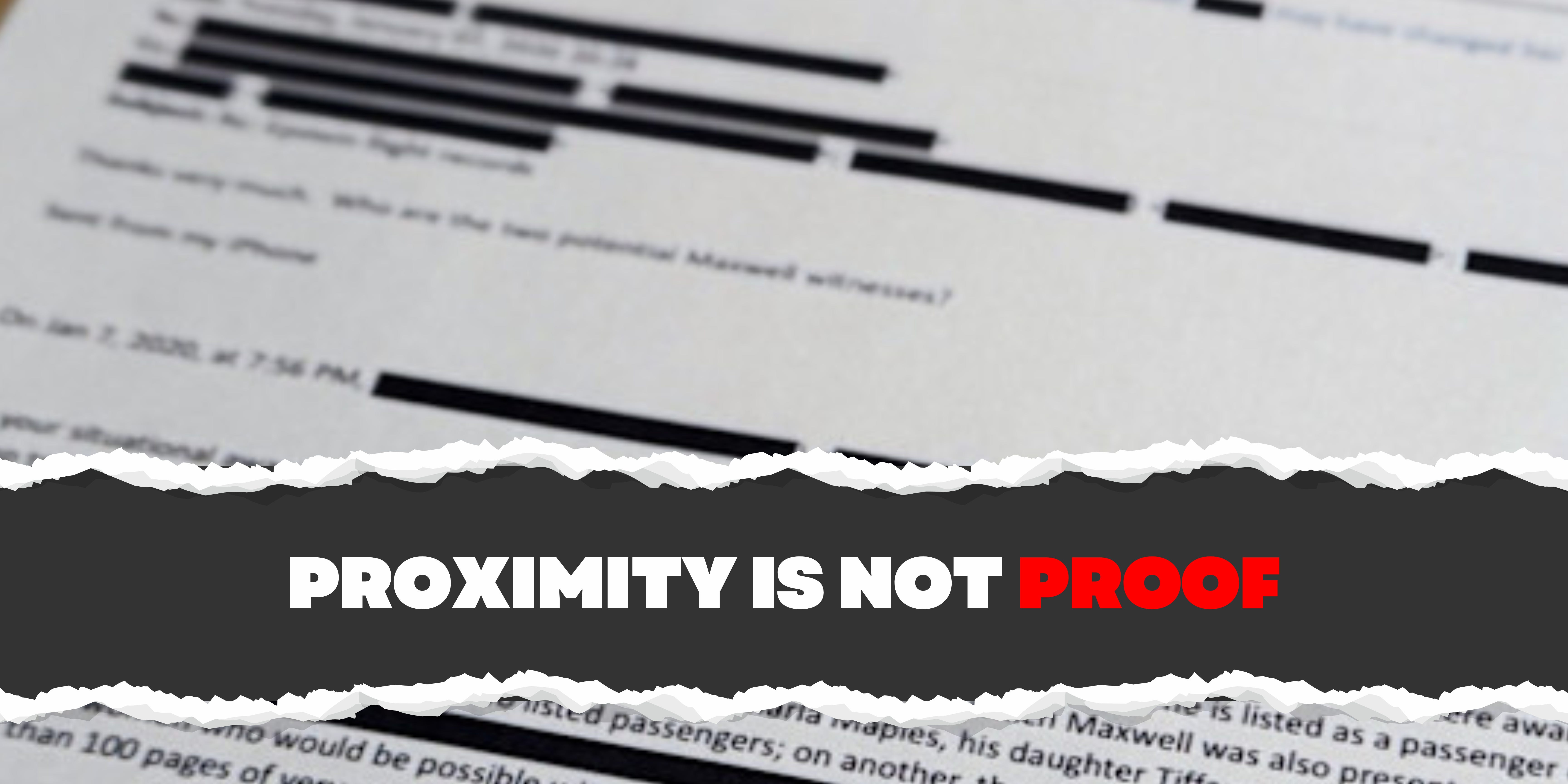
Proximity Is Not Proof

Jeffrey Epstein was a predator. That is not in dispute. Young women were abused. Power was exploited. The crimes were real, and the victims deserve justice that is serious, not symbolic.
But seriousness cuts both ways.
The release of large portions of the Epstein files has reignited public outrage, understandably. When criminal behavior intersects with wealth and political access, transparency is not optional. In a country already strained by distrust, even the perception that elites shield elites is corrosive.
If wrongdoing was protected by influence, it must be exposed.
No one should be above the law.
And yet, the way this moment is unfolding risks undermining the very justice it seeks.
Investigative files are not verdicts. They are archives of inquiry — containing tips, interview summaries, third-hand allegations, duplicative records, and leads that went nowhere. Investigators document broadly because they must. Preservation is not validation.
In the court of public opinion, however, those distinctions disappear.
If a name appears frequently in a document release, it is treated as incriminating. If a public figure once socialized with Epstein, proximity becomes implication. Allegation hardens into assumed fact, frequency becomes depth, and association becomes guilt.
That is not how legal systems function.
Donald Trump and Jeffrey Epstein clearly moved in overlapping social circles in the 1990s and early 2000s. Photographs exist, public comments exist, and their association is documented. That proximity is politically damaging, but political damage and criminal liability are not the same.
A sustained social relationship, even an unwise one, is not proof of criminal participation or knowledge. The legal bar for prosecution is high by design. The burden of proof is rigorous because the cost of error is enormous.
It is also true that maintaining relationships after Epstein’s 2008 conviction raises legitimate moral questions. Continued association with a registered sex offender demands explanation, but moral discomfort is not criminal complicity. Questions require investigation, not assumption.
Seeking evidentiary discipline is not an act of protection for the powerful; it is an act of protection for the truth. If we convict by inference today, we leave the door open for the truly guilty to claim ‘witch hunt’ tomorrow. Real justice requires a scalpel, not a sledgehammer.
Part of what also makes this case combustible is human nature. Relationships at the highest levels of wealth and influence are often transactional. Access and opportunity can cloud judgment. People rationalize those they know. Some may have suspected more than they admit. Others may have underestimated the scale of abuse. Human beings are capable of moral blindness without participating in a criminal conspiracy.
Understanding that dynamic does not excuse abuse, but it explains how proximity can persist.
At the same time, the administration’s handling of this issue has not helped. In a low-trust environment, opacity breeds suspicion. Defensive rhetoric or inconsistent communication reinforces the instinct that something is being hidden. Even justified caution can appear as concealment.
But the solution to distrust is not a document avalanche.
Millions of pages cannot be meaningfully processed by the public. Excerpts circulate, and narratives harden within hours. With this volume of material, anyone can find a fragment that confirms what they already believe. That is not transparency, but rather interpretive chaos.
If we are serious about the truth, the path forward must be structured.
An independent special master or panel — a retired federal judge, experienced prosecutors and victim advocates — should review the entire archive. Completely, not selectively, and not politically.
That reviewer should categorize material by evidentiary weight, distinguish incidental contact from corroborated allegations, identify what was investigated and why charges were or were not pursued, protect victim identities, and issue a comprehensive public report.
Then testify under oath before Congress.
Sworn testimony introduces legal accountability. It allows bipartisan questioning, and most importantly, it forces clarity under penalty of perjury. In a low-trust era, accountability must be visible and structured.
The Department of Justice should, by definition, be the arbiter of this truth. But we have reached a point where the Department’s own proximity to political power has rendered it a ‘disqualified player.’ Whether through actual bias or the inescapable appearance of it, the DOJ can no longer provide the finality the country needs.
This moment is larger than any single political figure. It is a test of whether a republic can confront explosive information without abandoning evidentiary discipline. It is a test of whether we can demand accountability without surrendering due process.
If additional abuse occurred, survivors must feel this moment offers safety and justice — not spectacle. If powerful individuals shield wrongdoing, they must be held accountable. But justice achieved through disciplined investigation is durable. Justice declared through viral inference is not.
Proximity is not proof, allegation is not conviction, and transparency without structure is not accountability.
If we forget those distinctions now, we will not get to the bottom of this case. We will deepen the distrust that made it combustible in the first place.
Less outrage, more outcomes. Get clarity by subscribing to our Substack and following us on X @commonpolicy1