
The Strongman Illusion
Why the American Right’s Putin Fetish Defies Reality

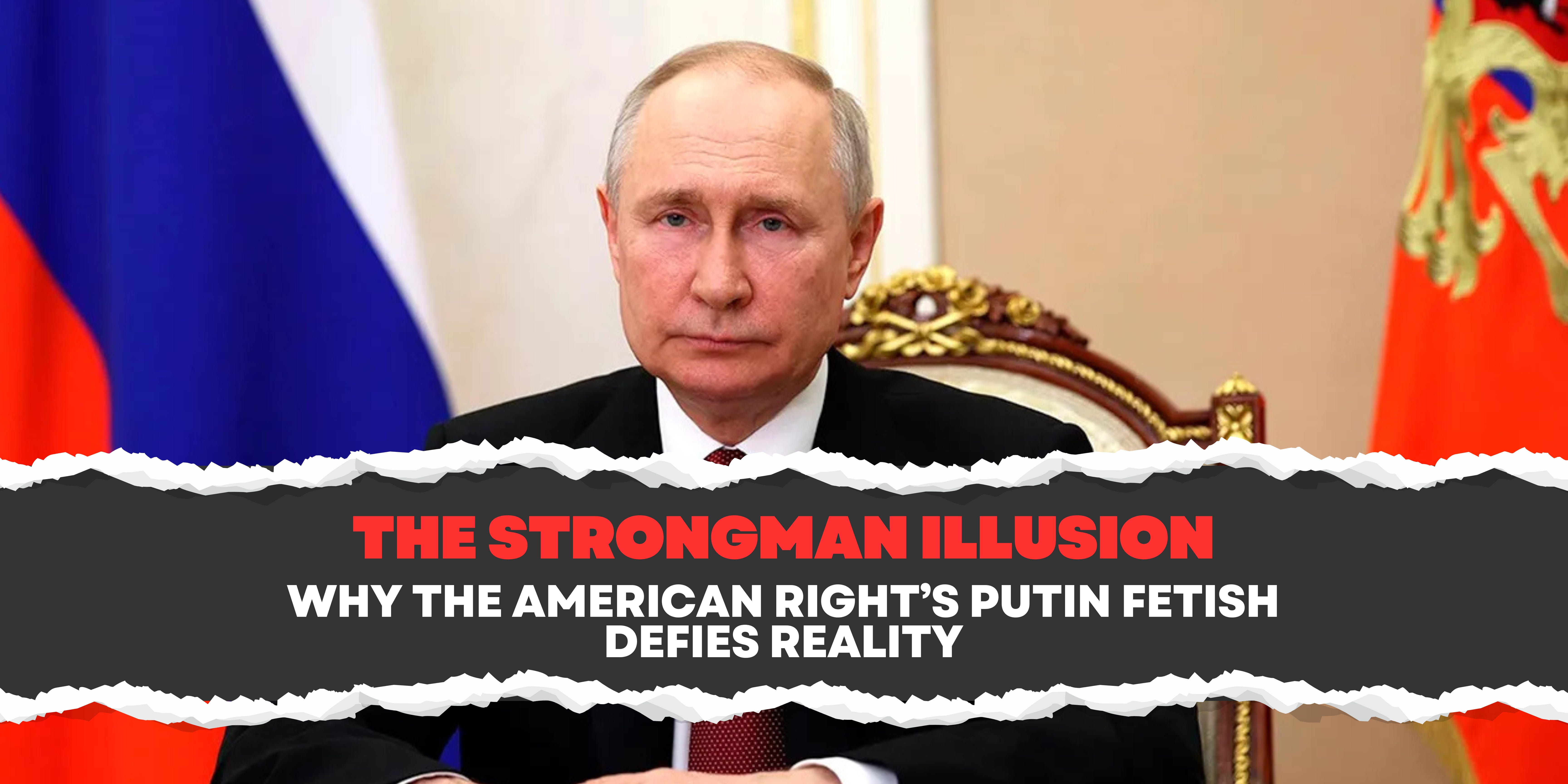
One of the strangest developments in American politics is not polarization, populism, or even the collapse of institutional trust. It is the growing admiration for Vladimir Putin and Russia among segments of the American far-right, an admiration that evaporates the moment you apply even a modest amount of scrutiny.
Many of our elected officials and media personalities, who made their reputation condemning government overreach, foreign misadventures, and abuses of power, now present Putin as a model of strength and stability.
Yet Putin represents failure in every measurable category of leadership. Russia, under his rule, has become one of the most dysfunctional major nations in the developed world. This is what makes the romanticism so incoherent. The same voices who insist that Western democracies have become tyrannical now praise a leader who murders journalists, poisons political opponents, jails critics, and criminalizes dissent.
Male life expectancy in Russia remains in the mid-60s—far below that of any advanced economy and closer to the developing world.
Russia’s population is shrinking, driven by low birthrates, high mortality, rampant alcoholism, and a widespread HIV/AIDS epidemic that the state still struggles to contain.
If inequality, preventable death, and social decay are indicators of national decline in the West, then Russia is the most damning example of collapse among major powers.
Economically, Putin’s record is equally dismal. After nearly a quarter century in power, Russia’s GDP remains roughly the size of Italy’s despite being nearly twice the population. The economy is still anchored in oil, gas, and raw commodities, not innovation or diversified industry.
Transparency International consistently ranks Russia among the most corrupt nations in the developed world.
Following the invasion of Ukraine, Russia experienced one of the largest brain drains of any modern country, with as many as one million young professionals fleeing to avoid repression or military conscription.
A country hemorrhaging its most capable citizens is not a rising power. It is a failing state propped up only by natural resources and security services.
Yet despite this record of decline, the admiration persists.
If the ‘pro-Russia’ crowd truly opposes reckless foreign policy, then Putin should be the last leader they admire. His invasion of Ukraine is now one of the greatest strategic blunders of the 21st century. U.S. intelligence estimates place Russian military deaths at more than 250,000, with total casualties, killed, wounded, and missing, approaching 900,000 to 1,000,000.
The scale of loss is staggering.
Russia has destroyed decades of military capacity in a conflict it expected to win in days. Meanwhile, the entire U.S. War on Terror—over two decades—led to roughly 7,000 American service-member deaths and fewer than 35,000 wounded in Iraq and Afghanistan combined. Our losses were tragic, but Russia’s losses are incomprehensible in scale. The contrast is not only stark, but it also exposes the hollow mythology surrounding Putin’s supposed strategic brilliance.
Politically, Russia is incapable of supporting the very freedoms that allow our politicians and media figures to build their careers. Opposition figures like Boris Nemtsov were assassinated in plain view, a signal to anyone who imagines challenging the regime. Critics like Alexei Navalny have been poisoned, imprisoned, or killed in custody. Independent media has been dismantled, foreign journalists expelled, and ordinary citizens arrested for social-media posts questioning the war.
The American populist right’s celebration of Putin requires an extraordinary suspension of reality. Every protection they claim to defend in the United States—free speech, dissent, press independence, individual rights—would result in their imprisonment or death in Russia. It is difficult to imagine a more self-defeating contradiction.
So why the fascination? Because Putin is not admired for his results. He is admired for his aesthetic. He projects dominance, certainty, and unrestrained authority. These are traits that appeal to those who mistake brutality for strength and equate chaos with authenticity. It is a fantasy of power, not an analysis of performance.
No one praising Putin wants Russia’s wages, its infrastructure, its alcoholism rates, or its crushed civil society. They want the illusion of control without the lived consequences of autocracy. They want the myth, not the man.
The truth is that Putin is not the embodiment of strength. He is the embodiment of what happens when a nation trades democratic complexity for the illusion of a single, unchallengeable ruler. Their fascination with that illusion has little to do with Russia itself and everything to do with an idealized vision of strength, masculinity, and Christian identity that they feel America has lost. And it is a reminder that the strongest nations are not built on fear or obedience, but on resilience, freedom, and the ability to correct their own mistakes.
Russia forfeited those qualities decades ago. The only real danger is if we forget that they are the source of our strength, and always have been.
Less outrage, more outcomes. Get clarity by subscribing to our Substack and following us on X @commonpolicy1